|
| Nested high upon the southwestern spur of Mount Parnassus, the stadium at Delphi is a gem at the end of a long and arduous mountain path. Originally built in the 5th Century BC, it was used to host athletic and musical events during the ancient Pythian and Panhellenic Games. The stone seating could accommodate as many as 6500 spectators. (Delphi, Greece.) |
 |
| Unlike at Delphi, we had some help when we climbed atop the Acropolis at Lindos. (Rhodes, Greece.) |
 |
| In April 1933, a severe earthquake—measuring 6.6 on the Richter Scale—razed the port city of Kos, claiming the lives of 170 people in a 27-second flash of destruction. Despite the catastrophic damage caused by the earthquake, it also revealed that the port district's aging houses were built directly atop the ruins of the ancient city—a discovery that precipitated the excavation of the largest archaeological site on the island. (Kos, Greece.) |
 |
| The Old Town of Rhodes is one of the most extensive and well-preserved medieval towns in Europe. Prior to the Ottoman incursion of Western Europe, Rhodes was controlled by the Knights Hospitallers. The Avenue of the Knights—located in the shadow of the Palace of the Grand Master—was the heart of the Medieval town, a meeting place and residential area for the Knights who defended the city for more than two centuries. (Rhodes, Greece.) |
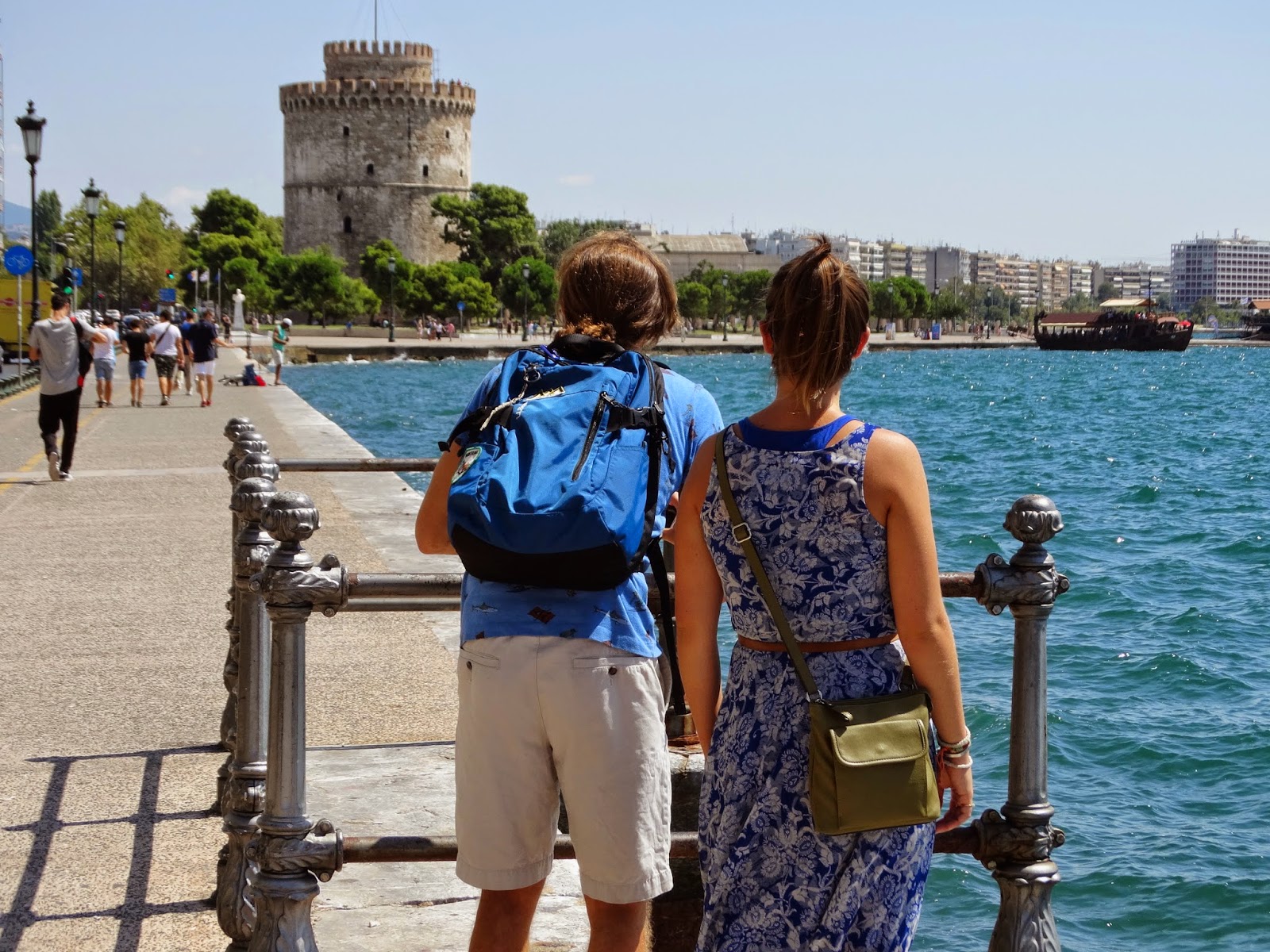 |
| The White Tower of Thessaloniki, once a notorious prison known as the site of mass executions during the Ottoman rule of Greece, has since been adopted as the symbol of the city. After four centuries of occupation, the old fortification was substantially remodeled—its exterior whitewashed, too—as a symbolic act of forgiveness and cleansing. (Thessaloniki, Greece.) |
 |
| Taking in the scene at Meteora, which must be one of the most beautiful sites in the entire world. Soaring above the red-roofed town of Kalabaka, the monoliths of Meteora are mystifying, surreal, and breathtaking. The six active monasteries there, built into the smooth sandstone pillars, have been sites of quiet contemplation and pilgrimage since the 13th Century. (Meteora, Greece.) |
 |
| Meteora was an ideal coda to a summer full of travel, amazement, and learning. In retrospect, it seems beyond description—just like so many of the experiences we had in all of the places we went. (Meteora, Greece.) |