Showing posts with label Athens. Show all posts

Saturday, July 12, 2014

Oh, The Places You'll Go

An up close & personal look at the Ionic order, courtesy of one of the six columns supporting the Erechtheion's Northern porch. (Athens, Greece)
Attempting to pose outside of the Panathenaic Stadium while security guards blew their whistles at us. The stadium, which was reconstructed from the remains of an ancient Greek stadium, played host to the first modern Olympic Games in 1896. (Athens, Greece)
The towering Temple of Olympian Zeus: an ill-fated structure that was constructed over a period of 638 years, only to be destroyed during a barbarian invasion 135 years after its completion.
(Athens, Greece)
The Passion façade of La Sagrada Família, which has been under construction since 1882. At the time of architect Antoni Gaudí's death in 1926, less than a quarter of the project was finished. It is currently scheduled for completion in 2026. (Barcelona, Spain)
Resting at the foot of La Catedral de Santiago de Compostela after completing the final 30 km of "El Camino de Santiago," a pilgrimage to the shrine of St. James that dates back to the 9th Century. (Santiago de Compostela, Spain)
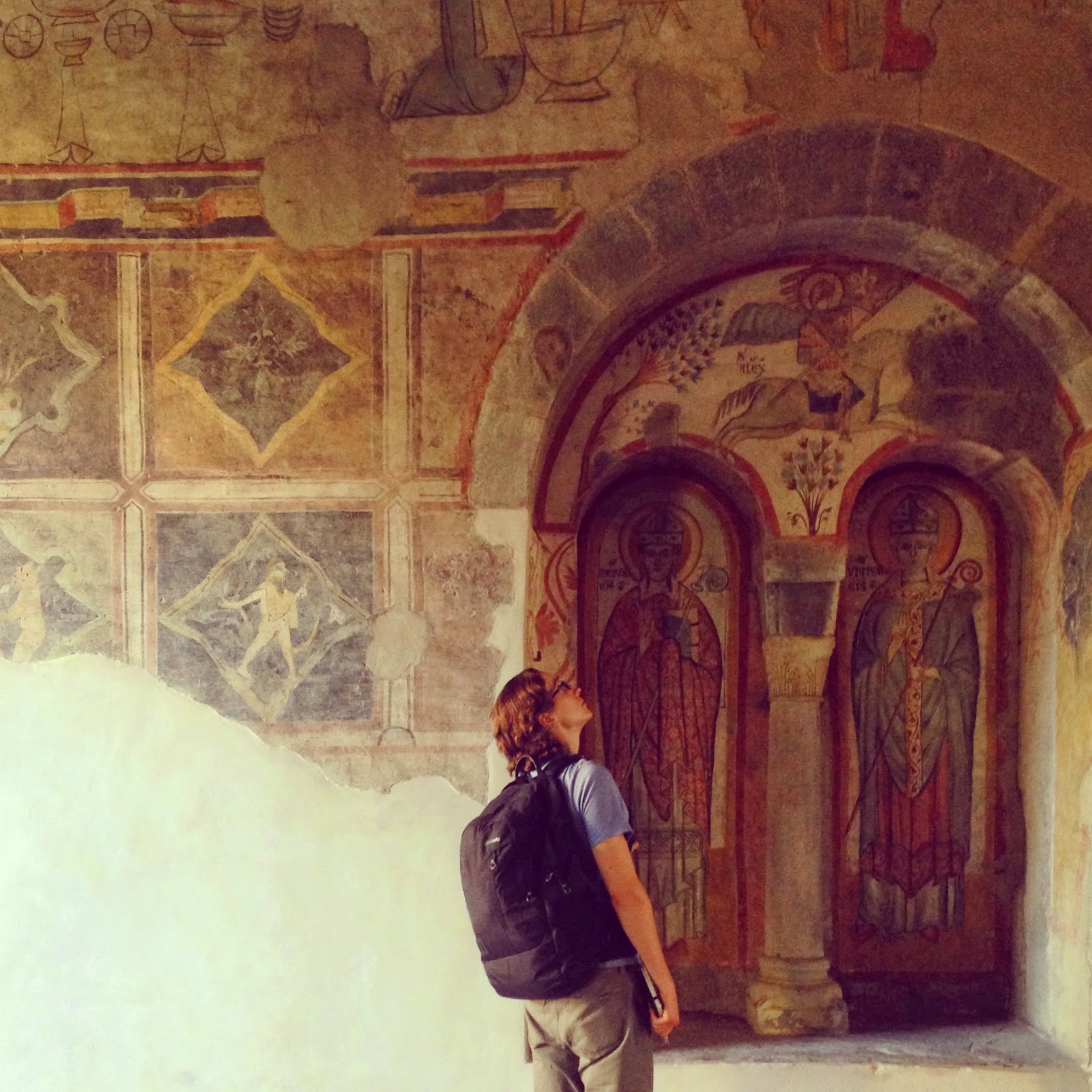
An unexpected encounter with a room full of 13th Century frescoes in La Città Alta: a truly breathtaking experience. (Bergamo, Italy)
The Temple of Poseidon at Cape Sounion, the southernmost point of Attica. As legend has it, King Aegeus leapt to his death at Sounion when he mistakenly thought that Theseus, his son, had been killed by the dreaded Minotaur. Thus, the Aegean Sea acquired its name. (Sounion, Greece)
The Odeon of Herodes Atticus, or simply "Herodeon," is a theater built into the southwestern slope of the Acropolis of Athens. Completed in 161 AD, it was turned to ruin in the same barbarian invasion that resulted in the destruction of the Temple of Olympian Zeus. We had the distinct pleasure of listening to Mozart's "Symphony No. 41," his final symphony, in the reconstructed venue. (Athens, Greece)
Situated on the southwestern face of Mount Parnassus, Delphi was once thought to be the center of the earth. The Delphic Oracle exerted extraordinary influence in the classical Greek world: she was consulted before all decisions of importance, perhaps as far back as 1400 BC. (Delphi, Greece)

Saturday, June 14, 2014

Hephaisteion


The Temple of Hephaestus, or Hephaisteion, is the most perfectly preserved temple remaining from the ancient Greek world. Built over the course of 34 years (449-415 BC), it is fitting that such a masterfully constructed Doric temple would be raised in honor of the patron god of craftsmanship. The temple is perched atop Agoraios Kolonos hill, in the shadow of the ancient Agora and Acropolis of Athens; its structure, forged from Pentelic and Parian marble, remains a sight to behold thousands of years on. Since words—it seems—can do no justice, I will allow my photographs to tell the rest of the story.

The Western Pediment, the Doric Colonnade, and the Ionic Frieze.
Another look at the temple's Western Pediment.
Looking Northwest to the Hephaisteion from the Acropolis.
Looking Southeast to the Acropolis from the Hephaisteion.
Hephaisteion: Ancient Greece's gift to the curious historian's imagination.


Saturday, June 7, 2014

The Acropolis

Looking towards The Acropolis of Athens.
While ascending the smooth, weathered stone pathways of the Acropolis, the weight of time looms heavily in the air. People from all corners of the earth have come to see one of the wonders of the ancient world for themselves; to witness a testament to the paradoxical continuity and transience of man.

When Samantha & I emerged from the metro station near Athens' Acropolis, six years had passed since I last visited. And as we climbed high above Greece's sprawling, historic metropolis, more than 2400 years had passed since the structures that we were about to see had been built.

The Acropolis of Athens- the epicenter of Classical Greece's most successful polis ("city state")- is a destination that naturally captures the imagination of it's modern visitors. Overlooking the Ancient Agora ("meeting place") of Athens, it features archaeological remains dating to a time long before man landed on the moon, before the "New World" was known to the Old World, and preceding the days when a man named Jesus resided in Nazareth.


The Propylaea.
Like all of the Acropolis' visitors, Samantha & I passed through the Propylaea: a remnant of the Periclean Building Program of the 5th Century BC. The construction of the monumental gate began in 437 BC, only to be terminated five years later due to the outbreak of the Peloponnesian War between Athens and Sparta. Though the Propylaea was never completed, the resultant structure was spectacular enough to have inspired later architectural achievements such as the Brandenburg Gate of Berlin.

However magnificent, the Propylaea cannot adequately prepare its visitors for their next encounter: the Parthenon. Dedicated to Athena, the goddess of Wisdom and patron of Athens, the temple is the most important surviving building from Ancient Greece. 


The Northeast corner of The Parthenon.
Survival has not come easily, though: The Parthenon has stood witness to the harsh passage of time, people, and regimes. It was built in nine years, from 446-438 BC, and became renowned as one of the great cultural monuments of the world. The Doric colonnade, the metopes, the frieze, and Phidias' Athena Parthenos represented the highest achievements of Athenian art & architecture. Later, though, a fire would destroy the roof & much of the temple's interior in the 3rd Century. The Parthenon was then rebuilt and remained intact- first as a Church, and then as a mosque under the control of the Ottoman Turks. The building survived as such until September 26, 1687, when it was struck by a Venetian mortar round, igniting an Ottoman ammunition dump within the temple's confines. The damage was catastrophic and accounts for the half-ruined state of today's Parthenon, which has been in various stages of restoration since 1975.

The wondrous beauty of the Parthenon is paralleled yet by the grace of the Erechtheion. Built between 421-406 BC, the temple was dedicated to Athena & Poseidon and is best known for "The Porch of the Caryatids," in which six female figures act as supporting columns. The Erechtheion was built precisely to fit the uneven terrain of the Acropolis Hill; it is the crown made to fit the head of Ancient Athens' sacred rock. 


The Erechtheion, Parthenon, and their admirers.
And so it is no wonder why so many citizens of the world flock to see what has been seen, photographed, and written about to no end. The Acropolis constitutes a very tangible connection to the ancient peoples who made such crucial contributions to the world of art, scholarship, and politics. It stands as a very weathered- and very beautiful- lens through which we may view a society that inspired countless others.