Showing posts with label New York. Show all posts

Thursday, February 13, 2014

"Ladies and Gentlemen, The Beatles!"

"Quick, get a picture of me with The Beatles!"
Fifty years ago, on Feb. 9, 1964, Ed Sullivan’s now-famous words rang out across the airwaves, only to be immediately drowned out by the piercing, high-pitched screams of the 728 audience members in attendance at CBS Studio 50.
The Beatles’ debut appearance on “The Ed Sullivan Show” was so much more than a performance for several hundred swooning fans in a New York television studio. That night, an estimated 73 million viewers tuned in across the United States to watch the hour-long program, according to The New York Times, shattering the previous record for television viewership.
Years later, in an interview for “The Beatles Anthology,” George Harrison would remark, “We were aware that ‘Ed Sullivan’ was the big one because we got a telegram from Elvis and the Colonel. And I’ve heard that while the show was on there were no reported crimes, or very few. When The Beatles were on ‘Ed Sullivan,’ even the criminals had a rest for 10 minutes.”
As The Fab Four launched into a pulsing rendition of “All My Loving” to open their set, it was clear that the British Invasion — and, more specifically, Beatlemania — had taken America by storm.
The Beatles’ five-song set, which included such timeless hits as “She Loves You” and “I Want To Hold Your Hand,” was filled with numerous quirky and iconic moments.
A bewildered John Lennon takes note of his special introduction.
(Note: His reaction quickly transformed into amusement.)
Memorably, as Paul McCartney sang a cover of “Till There Was You,” a ballad written by Meredith Wilson for the 1957 musical “The Music Man,” the band members were introduced in a succession of close-up shots as their names flashed across the screen. When the camera settled on John Lennon, the caption read: “SORRY GIRLS, HE’S MARRIED.”
Though the dreams of Lennon’s innumerable female admirers were crushed that night, the real dream was only beginning. Over the coming years, The Beatles would change the face of the popular music scene forever.
The performance on “The Ed Sullivan Show” was the catalyst for a cultural phenomenon that is still alive and well today. The band would go on to appear on the program the following two Sundays and by April, Beatles songs occupied each of the top five spots on Billboard’s Hot 100 chart.
With more than 600 million albums sold worldwide, The Beatles are the best-selling band in history. Their level of success was, and is, so extensive that a compilation album titled “1” was released in 2000, comprising the band’s 27 No. 1 singles.
Paul McCartney and Ringo Starr perform at Los Angeles
Convention Center as part of "The Beatles: The Night
That Changed America- A Grammy Salute."
Just a few weeks ago, Ringo Starr and Paul McCartney reunited at the 56th Annual Grammy Awards to perform “Queenie Eye,” a song from McCartney’s recently released album, “New.” 
They took the stage again for a CBS special Sunday night, “The Beatles: The Night That Changed America — A Grammy Salute,” surrounded by contemporary A-list performers like Alicia Keys, John Legend and Katy Perry, and the two remaining Beatles reaffirmed their status as hyper-relevant musical icons.
But 50 years ago, as they waited backstage for Ed Sullivan to introduce them to America, John, Paul, George and Ringo were just four young lads from Liverpool, unaware they were on the verge of inciting a pop culture revolution. Imagine that.
Republished with permission of The Lantern, thelantern.com, Ohio State University.

Sunday, January 5, 2014

Pizza: A Delicious History

Pizza. The word itself evokes feelings of comfort, happiness, and satisfaction. No matter the context in which it is consumed- a quick slice on the go, a consolation pizza after a disappointing Ohio State loss, etc.- pizza possesses the uncanny ability to fill any void, be it voracious hunger or crippling sadness. It seems that a food so perfect, so intrinsically good, would have been around since the dawn of man. Pizza as we know it, however, has a surprisingly brief history.

The word "pizza" has been around for quite some time, having appeared in writing for the first time in 997 AD. The Latin text in question proclaimed that one of the citizens of Gaeta was to present the bishop of the southern Italian town with twelve pizzas each Christmas and Easter Sunday (Priestley, 2010). If you ask me, the bishop of Gaeta's gig sounds pretty awesome, even if the "pizzas" he received bore little resemblance to the modern-day dish. The duodecim pizza ("twelve pizzas") likely resembled one of several flatbreads that existed across the Mediterranean, many of which are still around today.

Naples, Italy: The Birthplace of Pizza.
Plakous was a flatbread consumed by the ancient Greeks, flavored with herbs, onion, and garlic ("The History of Neapolitan Pizza"). The ancient Etruscans are said to have invented focaccia bread, while coca was and is a popular pizza-esque dish in Catalonia, Valencia, and the Balearic Islands. During the 16th century, the Galette flatbread- a dish popular among Naples's poorer inhabitants- began to be referred to as pizza (Baxter, 2013). Another great development of the 16th century, the tomato was introduced into the European diet amidst the conquest of the Americas. Within generations, it became common for the natives of Naples to add tomato to their yeast-based flatbreads- paving the way for the creation of humankind's greatest culinary achievement.

Pizza Margherita.
Raffaele Esposito is credited as the inventor of modern pizza, having created the dish in 1889 at Pizzeria di Pietro in Campania, Italy (Bellis, 2014). Esposito crafted his pizzas specially for the visiting King and Queen of Italy, Umberto I and Margherita. The Queen's favored pie was one that matched the colors of the Italian flag, topped with basil leaves (green), mozzarella (white), and tomatoes (red). Thus, the "Pizza Margherita" was named in her honor.

Pizza made its first appearance in the United States as Italian immigrants arrived in cities such as New York,  Chicago, Philadelphia, and St. Louis at the end of the 19th Century. In 1897, Gennaro Lombardi opened a grocery store in New York that would become America's first pizzeria when it received its mercantile license in 1905 ("Lombardi's Pizza"). Though pizza consumption was mostly limited to Italian immigrants in America, after World War II American troops who had been stationed in Italy brought their affinity for the dish back home with them.

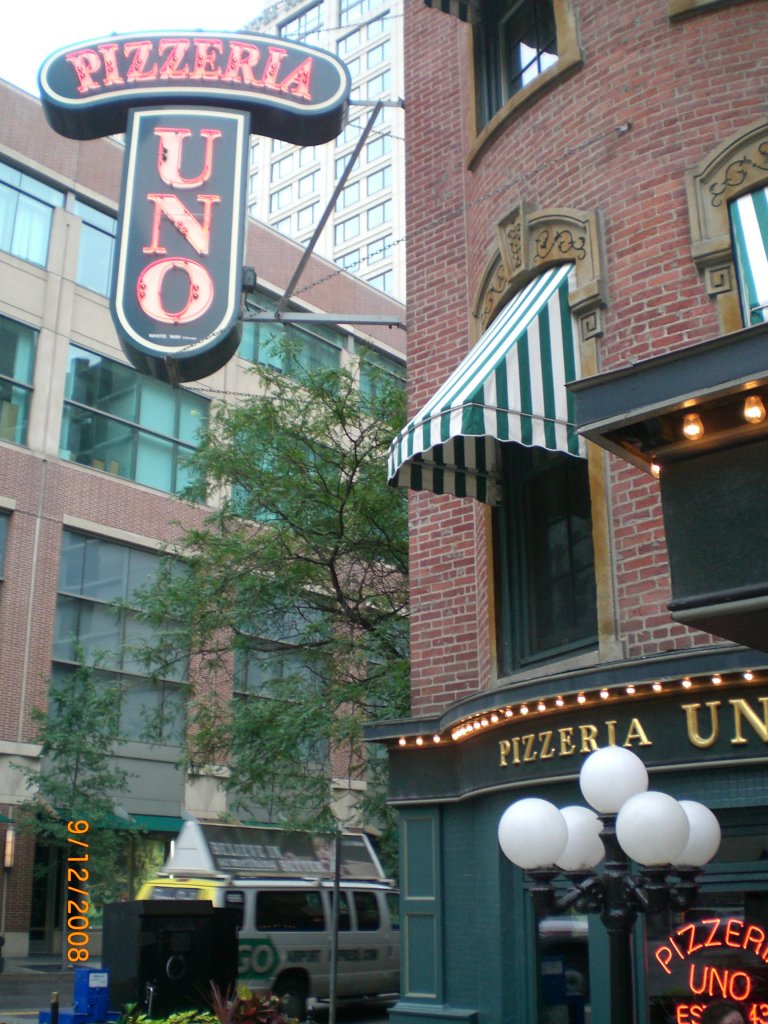
Pizzeria Uno in Chicago, IL.
In 1943, Ike Sewell and Ric Riccardo invented deep-dish pizza, opening Pizzeria Uno on the corner of Wabash and Ohio in downtown Chicago (Vettel, 2013). In addition to Chicago, other American cities such as New Haven, Detroit, and Youngstown (yes, that Youngstown) created their own adaptations of the dish. With pizza's rapidly rising popularity, chain restaurants began to spring up around the nation (Pizza Hut, for example, was established in 1958 in Wichita, Kansas- thus, beginning its quest to create the most mediocre pizza possible).

Today, national chains with a focus on delivery such as Papa John's, Donatos, and Domino's have a stronghold on the pizza market. However, pizza enthusiasts continue to flock to their local joints (Columbusites: I highly recommend Catfish Biff's and Adriatico's) in search of the perfect pie- a lifelong quest that I, and many others, enjoy to the fullest. Pizza- oh, glorious product of Napoli- we salute you.

_________________________________________________________________________________

Baxter, Meaghan. "Where It All Began." Vue Weekly. Aberdeen Publishing, 21 Feb. 2013. Web. 05 Jan. 2014. <http://www.vueweekly.com/where_it_all_began/>.

Bellis, Mary. "The History of Pizza Pie." Inventors. About.com, n.d. Web. 04 Jan. 2014. <http://inventors.about.com/od/foodrelatedinventions/a/pizza.htm>.

Priestley, Rachel. "That's Amore!" TheFlorentine.net. The Florentine, 23 Sept. 2010. Web. 03 Jan. 2014 <http://www.theflorentine.net/articles/article-view.asp?issuetocId=6101>.

"The History of Neapolitan Pizza." Famoso. Famoso Neapolitan Pizzeria, n.d. Web. 02 Jan. 2014. <http://www.famoso.ca/history.php>.

Wednesday, September 11, 2013

Remember

Every year since 2001, September 11th has carried with it an air of solemn reflection. The events of that day live on in infamy, much like the attacks on Pearl Harbor that occurred sixty years before. Please take a few moments out of your day to honor the memory of the 2,977 victims of the attacks, and to remember the resilience of the community's response in the wake of tragedy. We all watched the world change that day, in so many ways.